


Introduction
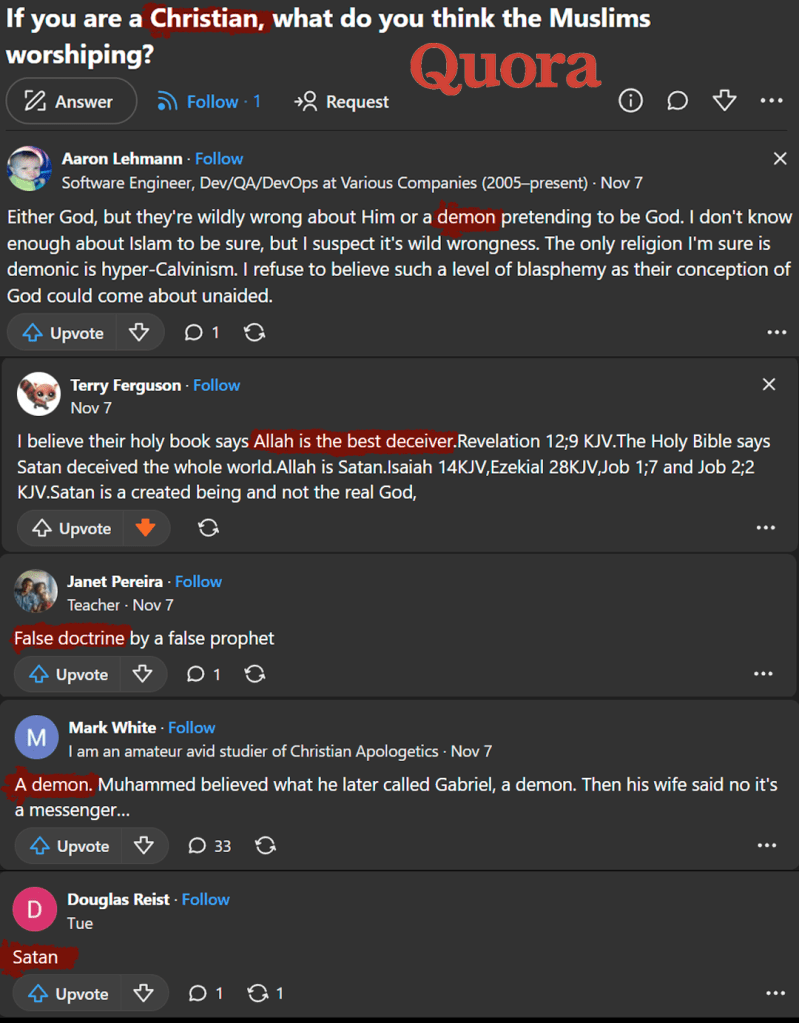
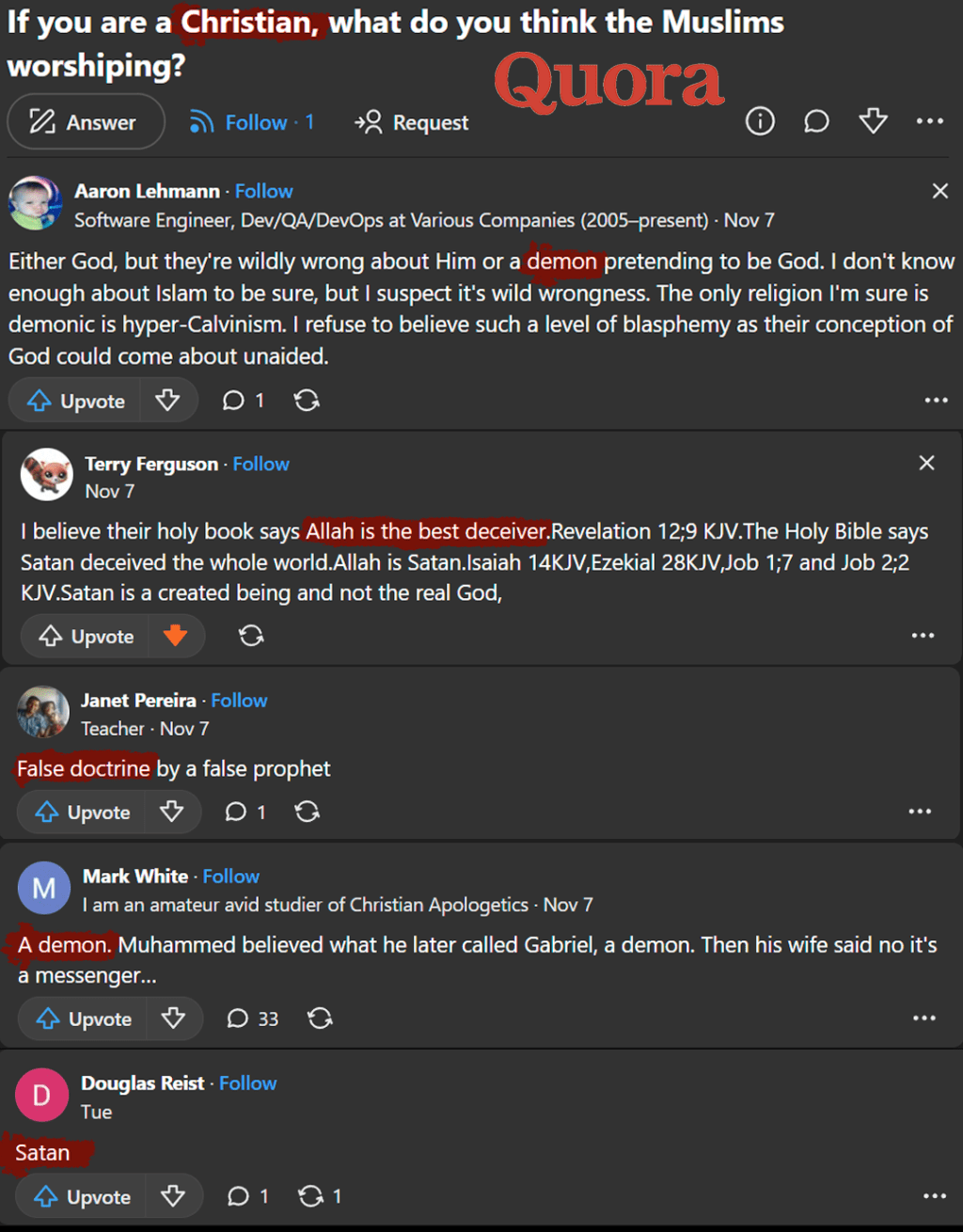
I am new to the field of apologetics. The first time I encountered this accusation was during a debate with a Christian brother on Quora. He repeatedly accused me of practicing taqiya while quoting a verse from the Quran that he claimed implies something like “Allah is the best deceiver.” This accusation was strange to me, as I always check every fact before presenting it to support my arguments. Even Rasulullah (PBUH) emphasized the importance of truthfulness:
“Truthfulness leads to righteousness, and righteousness leads to Paradise. And a man keeps on telling the truth until he becomes a truthful person. Falsehood leads to wickedness, and wickedness leads to Hell…”
(Sahih al-Bukhari, 6094; Sahih Muslim, 2607)
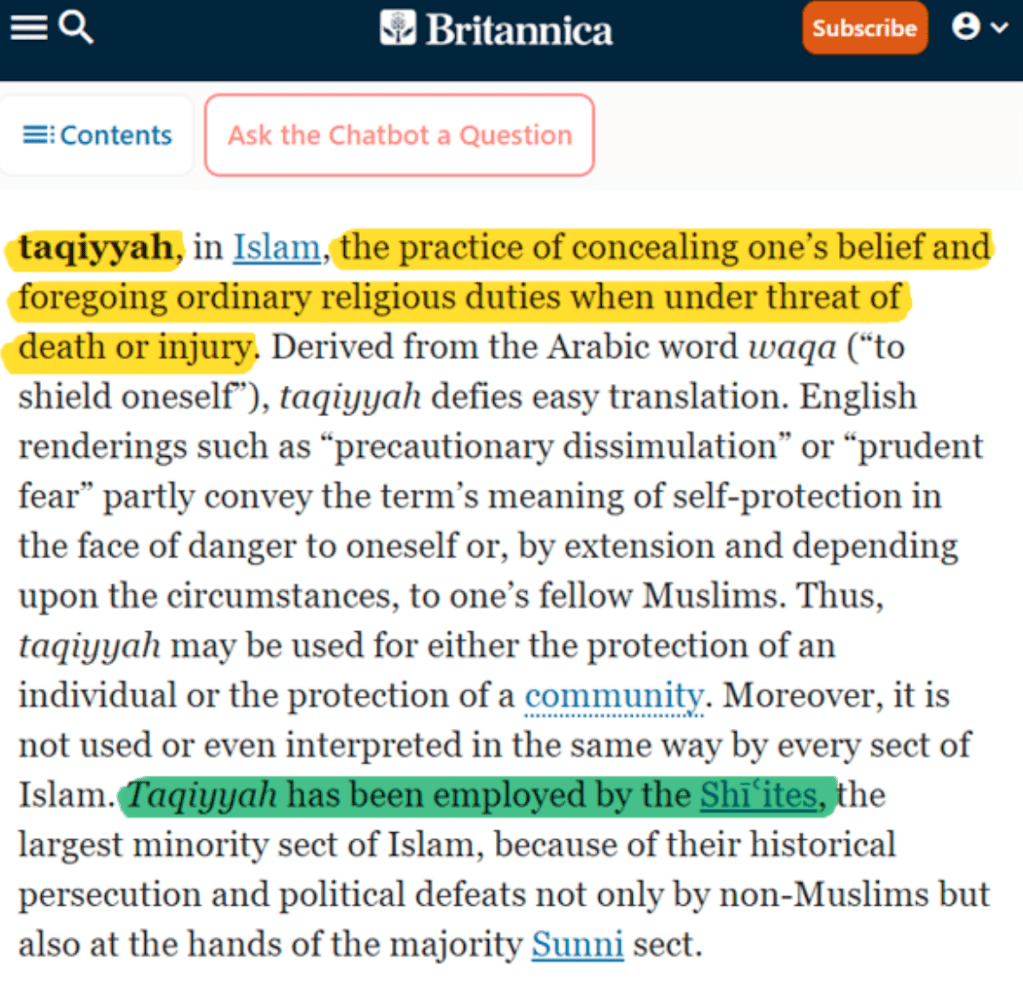
I was so confused and started reading to grasp what the heck it was all about. It turns out that Taqiya (also spelled as taqiyya, taqiyyah, or taqiyah) originates from the Arabic word “waqa,” meaning “to shield oneself.” It refers to the practice of concealing one’s beliefs and foregoing ordinary religious duties when under threat of death or injury.[1]
What Was The Accusation Again?
At least from my experience, they accused me and Muslims entirely of being deceivers due to the statement Allah made in the event where Jesus (PBUH) ascended to avoid being crucified. The verse referring to that event is from Surah Ali-Imran:
And they [i.e., the disbelievers] planned, but Allāh planned. And Allāh is the best of planners.
Surah Ali ‘Imran 3:54
But it’s strange because the translation is “the best of planners.” Even if we use online Quran platforms like Quran.com and turn on all English translations, we cannot find this word.
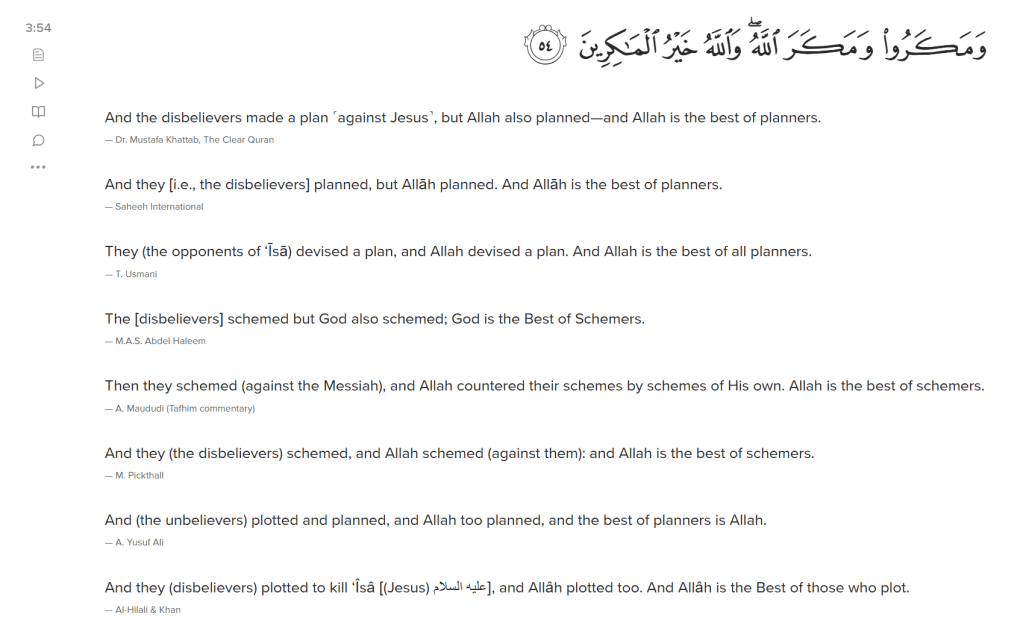
The variants of the translation we have here are “schemers” and “plot.” So, where is this “deceiver” coming from? Well, MAYBE some of them interpret “schemers” as “deceivers”, I thought. It turns out, we can find it here: https://www.islamawakened.com/quran/3/54/default.htm
It’s amazing to think that, out of all 45 English translations provided on the page, they managed to find this one anomaly:
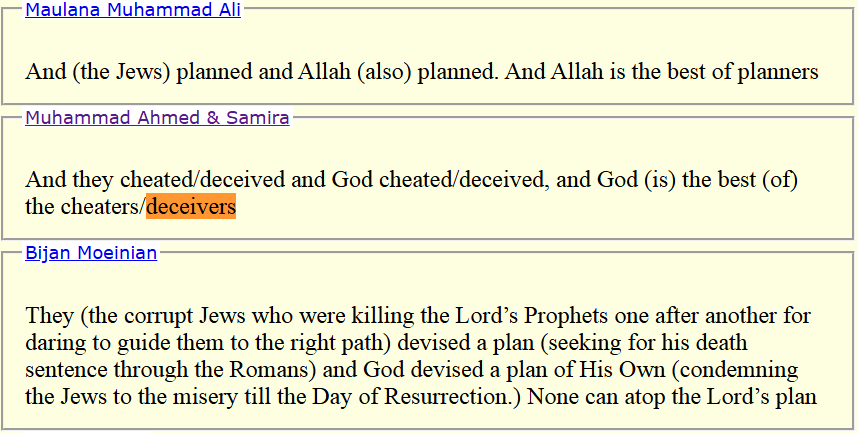
I have to squint my eyes to search for the words and then give up after few minutes. I only found the alleged translation using Ctlr+F. Because of this translation, they accuse us preaching our faith by deceiving people. If a Christian make this accusation, it’s a fun ride to argue with them because the taqiya (according to their understanding which lying and deceiving) exist blatantly in their scripture. Before we leave them stunned and choking on their own arguments, let’s delve deeper into the accusations being made.
Does It Really Exist In Islamic Tradition?
As far as my knowledge, it’s happened once. It’s not even a practice on daily basis in peaceful situation. Remember the explanation by Britannica above; concealing one’s beliefs. We don’t pretend to be a Christian, or a Jewish, or a Hindu then preach Islam in their community. Everyone will know we are Muslims especially with the sisters who have their hijabs. Not to mention we have to constantly look at the watch to make sure we don’t miss our salah. Forget fasting in Ramadhan, where our face will look like a half-dead zombies on the first few days.
The example of the situation of concealing one’s believe in dangerous situation can be seen in Surah An-Nahl (16:106) :
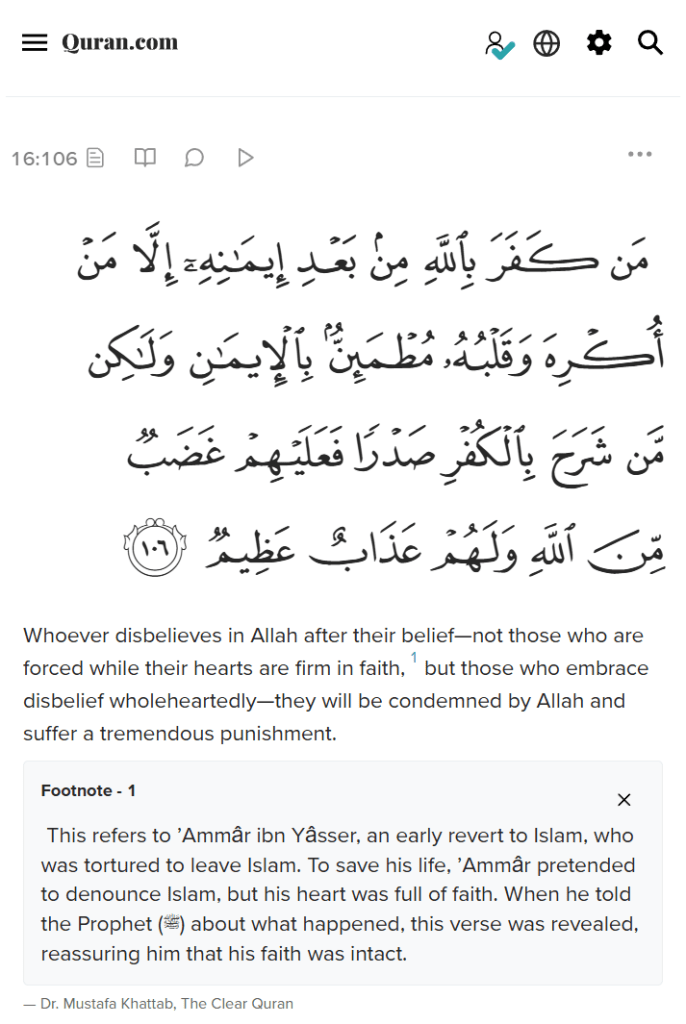
In this verse Allah affirmed that anyone being forced to disbelieve while his hearts are firm to the faith has nothing to worry about. In the footnote provided there is an example of such case.
Britannica notes that the practice of taqiyyah—concealing one’s faith to protect oneself from harm—is particularly significant in Shia. While we can discuss the last part of the explanation later, this taqiya thing only exclusive to conceal our faith when our life is in danger. Not as a practice for preaching Islam.
Shia?! I’m Sick & tired of It! You Guys Are All The Same! This Indeed Taqiya! Lies!
Well, it’s either the people who said this are liars pretending not to understand the concept of sects in religion, or they are genuinely clueless. However, it’s not rocket science and is actually quite easy to comprehend. We are going to see other sects in all major religion to understand the concept.
Christian

The Troubles in Northern Ireland (Late 1960s–1998) date back to centuries of warfare in which the predominantly Catholic people of Ireland attempted to break free of British (overwhelmingly Protestant) rule.[2] Yes it’s politics but that exactly what Shia and Sunni is. It’s politic rival about who should be the first khalifah to be the sucessor after the prophet passed away. Except, between Protestant & Catholics, they read different books:
Protestant Bible:
- Old Testament: 39 books
- New Testament: 27 books
- Total: 66 books
Catholic Bible:
- Old Testament: 46 books (includes 7 additional books known as the Deuterocanonical books)
- New Testament: 27 books
- Total: 73 books
While Sunni and Shia believe in the same God, same Prophet, and probably the same book, Shia reject some companions of Rasulullah, affecting the chain of hadith transmission. They also recognize the authority of the Twelve Imams as divinely guided alongside the Quran and Hadith. This opens many windows to certain practices that are rejected by ijma’ (consensus).
The same way no Protestant would say they are Catholic or Jehovah’s Witness or the Mormon, the same applies to the case of Sunni and Shia.
Judaism
They don’t bother about anyone else. No point of mentioning them.
Hinduism
The “I’m tired of Shia Sunni” also coming from this group of people. This religion is unique in the sense that it accepts everything as a potential way to reach God. However, there are also refutations among them, particularly between different schools of thought like Advaita Vedanta (Non-Dualism) and Dvaita Vedanta (Dualism). Advaita is criticized by Dvaita philosophers for denying the personal relationship between the soul and God, which they argue is central to devotion.
See? Everyone has sects! Lol…
So What?
So, what Shia practice has nothing to do with the Sunni. Even if you do the research further about taqiya in Shia, there is nowhere that suggests Shi’ites preach their beliefs by deceiving people. The practice of taqiya is solely for the purpose of protecting their lives during times of conflict or persecution, not for spreading their beliefs through deception.
So What’s Funny About It?
It’s funny if the accuser is a Christian. Why, you ask? Considering the concept of taqiya as propagated by Christian missionaries—claiming that Muslims preach their religion by deceiving people—they can then be asked about their own conman, the “Fake Apostle,” Paul.
“To the Jews I became as a Jew, in order to win Jews. To those under the law I became as one under the law (though not being myself under the law) that I might win those under the law. To those outside the law I became as one outside the law (not being outside the law of God but under the law of Christ) that I might win those outside the law. To the weak I became weak, that I might win the weak. I have become all things to all people, that by all means I might save some.”
(1 Corinthians 9:20-22)
As the matter of fact, Jesus already prophesized the arrival of this conman:
“Beware of false prophets, who come to you in sheep’s clothing but inwardly are ravenous wolves.
(Matthew 7:15)
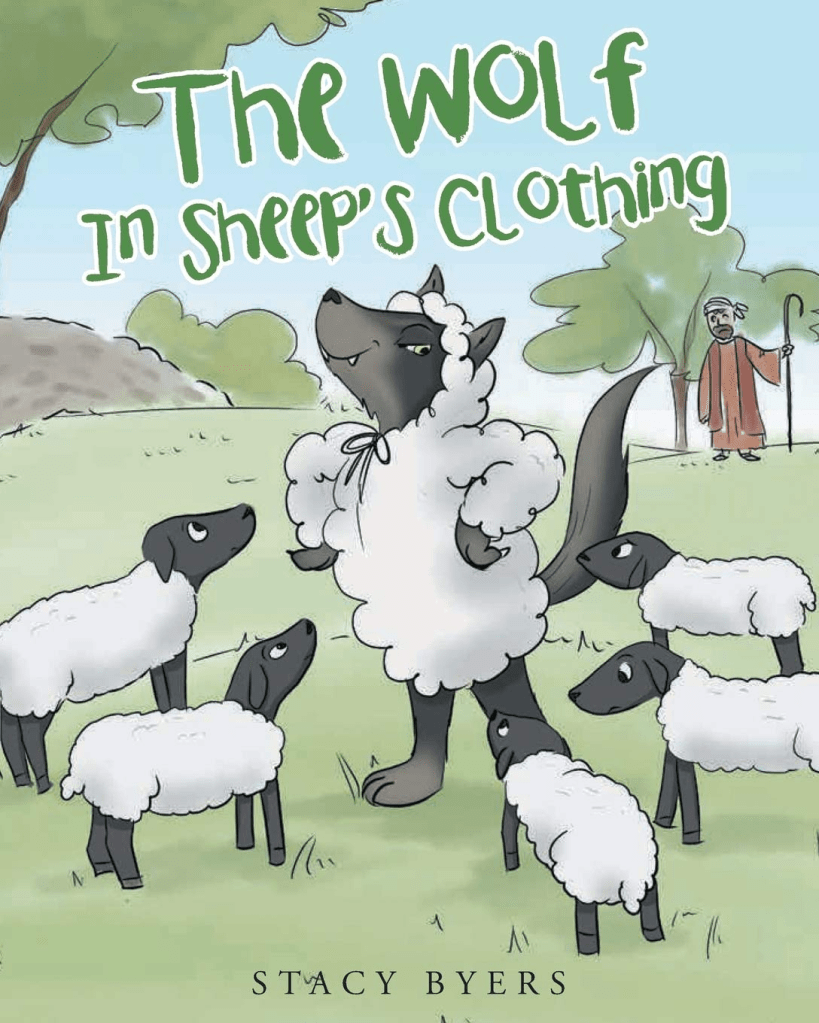
Even little children could tell you that only wolves disguise themselves as someone else.
Conclusion
This argument against Islam is undoubtedly strange. I was baffled when 1st time being thrown by this accusation. Islamic tradition emphasize that we have to be honest, sincere and truthful all the time, especially when delivering Allah’s message. I have wrote about how the syahadah will not be accepted if it was done by coercion or trick.
If the Christians still insists with this allegation, then they need to explain what the heck was Paul actually doing? I have keep an argument which YHWH put deceiving spirit into the prophet’s mouth. But that would make this article too long. I don’t debunk this issue using language technical argument because I doubt they will read it.
I guess this is enough. They need to stop the accusation to avoid looks like a fool.
“Say, ‘Indeed, those who invent falsehood about Allah will not succeed.”
Surah Yunus (10:69)







Citations:
- Encyclopaedia Britannica. (n.d.). Sunni. Britannica. Retrieved December 24, 2024, from https://www.britannica.com/topic/taqiyyah
- History.com Editors. (n.d.). The Troubles in Northern Ireland. History. Retrieved December 24, 2024, from https://www.history.com/news/the-troubles-northern-ireland


 Infiniti Islam
Leave a comment