

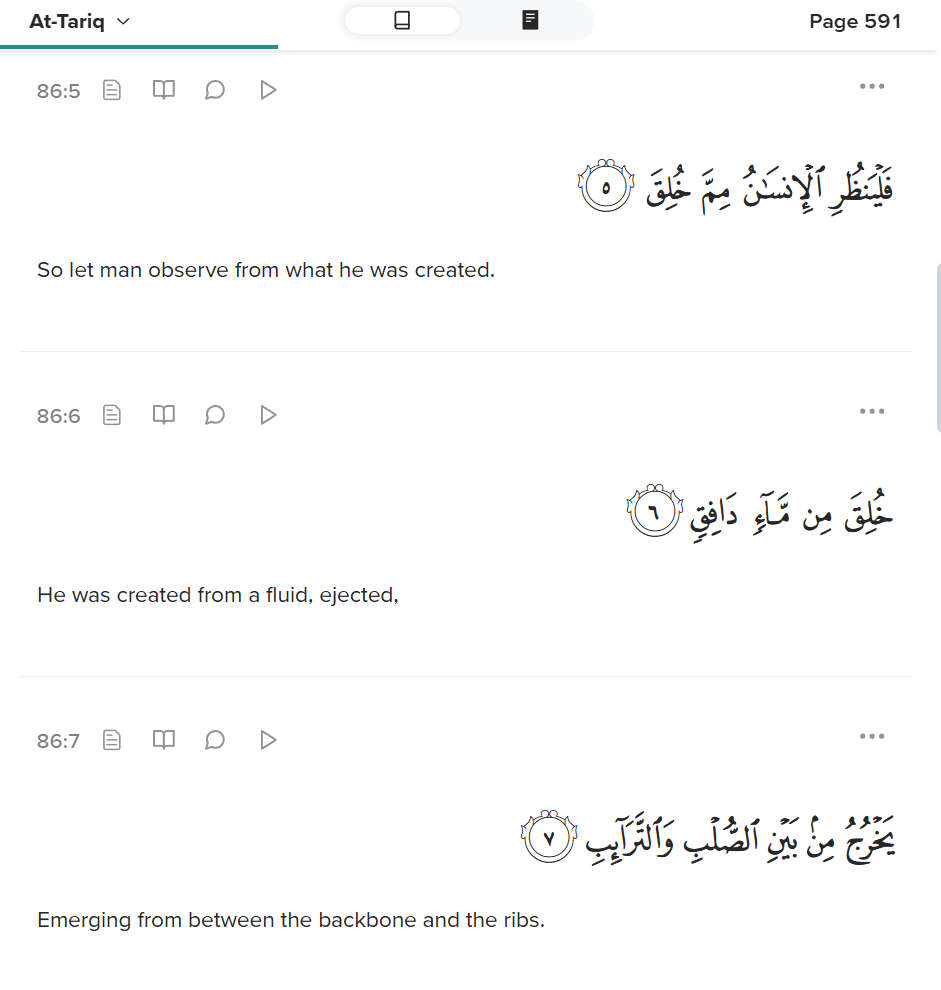
He was created from a fluid, ejected, Emerging from between the backbone and the ribs.
Introduction
Critics oversimplify this verse, asserting that it incorrectly claims sperm originates from the spine. This argument stems either from a lack of understanding or intentional misrepresentation of the Quranic language. Let’s delve deeper to unpack this misconception and explore the anatomical and embryological truths that align with this verse.
We are referring to the verses in Surah At-Tariq, verse 5-7:
No Mention of “Sperm and Spine”
First and foremost, the Quran does not specifically mention “sperm” or “spine.” The phrase “between the backbone and the ribs” refers to a region, not a specific bone or organ. Similarly, the statement “he was created from a fluid, ejected” does not exclusively refer to sperm. Explaining this verse is like dropping a mind-blowing truth bomb that will leave truth-seekers picking their jaws off the floor. This subtle yet significant detail opens up an epic exploration of human anatomy and development.
Journey Through Embryo Development
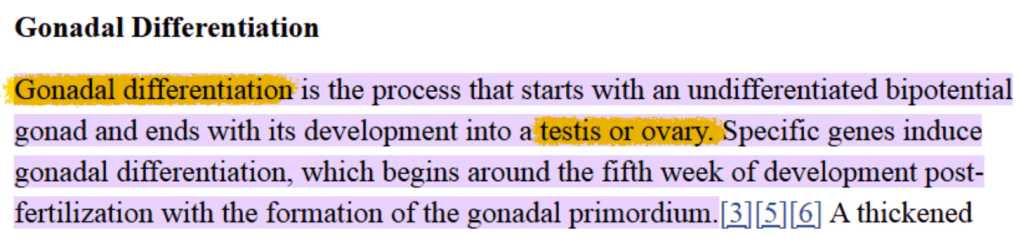
The development of the gonads is part of the prenatal development of the reproductive system and ultimately forms the testicles in males and the ovaries in females.[1][2]
During embryonic development, the testes originate near the kidneys, specifically in the lumbar region of the embryo. As development progresses, they descend into the scrotum, a process guided by the gubernaculum. This descent is crucial for proper testicular function and is influenced by various factors, including hormonal signals.[3]
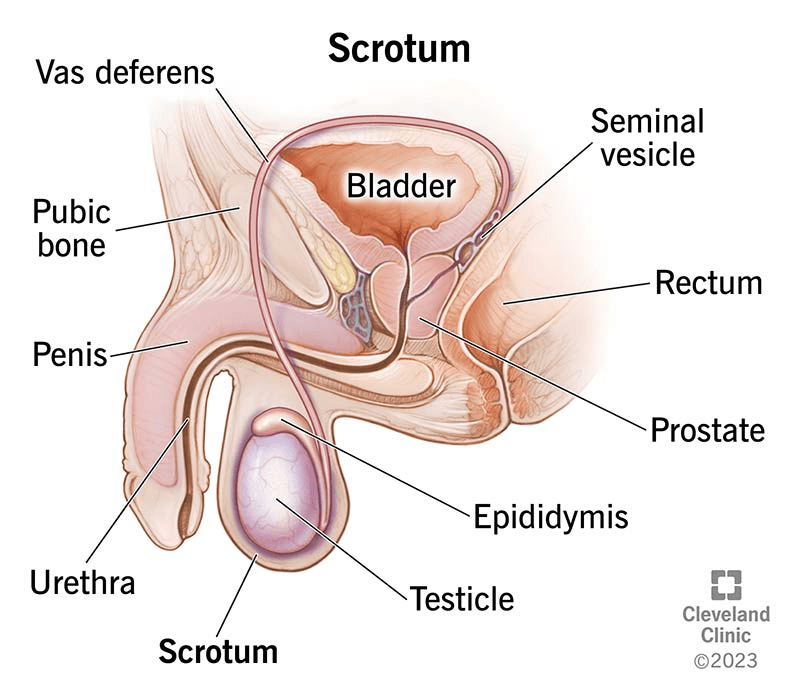
During embryonic development, the ovaries originate near the kidneys in the lumbar region of the embryo, similar to the testes. As development progresses, the ovaries descend to their final position within the pelvis. This descent is guided by the gubernaculum, an embryonic structure that connects the developing ovary to the future site of the uterus and labia majora.
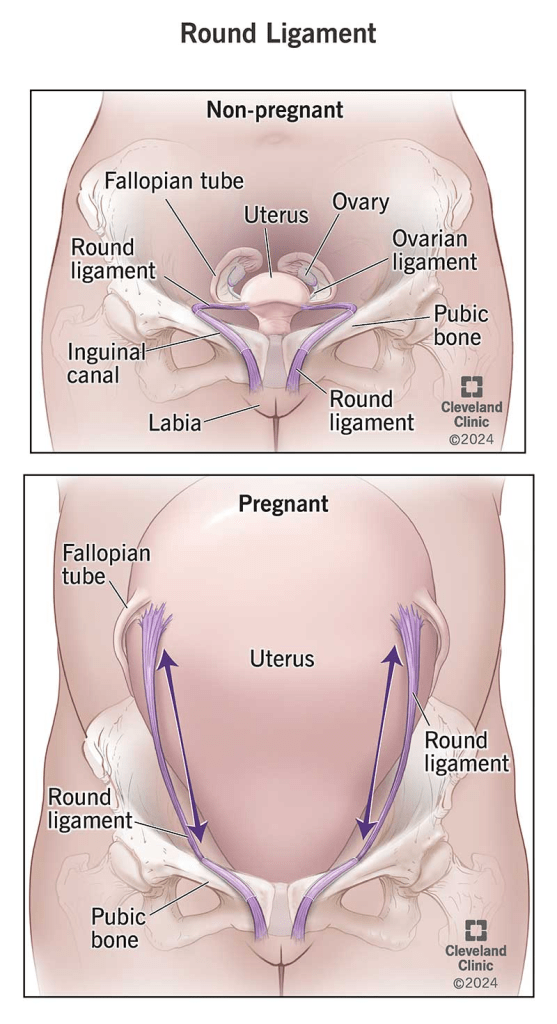
In females, the gubernaculum differentiates into two structures: the ovarian ligament, which connects the ovary to the uterus, and the round ligament of the uterus, which extends from the uterus to the labia majora. Unlike the testes, which descend into the scrotum, the ovaries’ descent is limited to the pelvic region, where they remain throughout life.[2][4]
The kidneys and reproductive organs develop from intermediate mesoderm, which differentiates into structures such as the pronephros, mesonephros, and metanephros during development. The mesonephros functions transiently as an embryonic kidney and contributes to the development of reproductive structures.[5]
The intermediate mesoderm is positioned laterally to the notochord and neural tube, structures that are along the midline of the developing embryo (closer to the spine).[5]
Intermediate mesoderm or intermediate mesenchyme is a narrow section of the mesoderm (one of the three primary germ layers) located between the paraxial mesoderm and the lateral plate of the developing embryo.[5] Paraxial mesoderm is essential in building the ribs by forming somite.
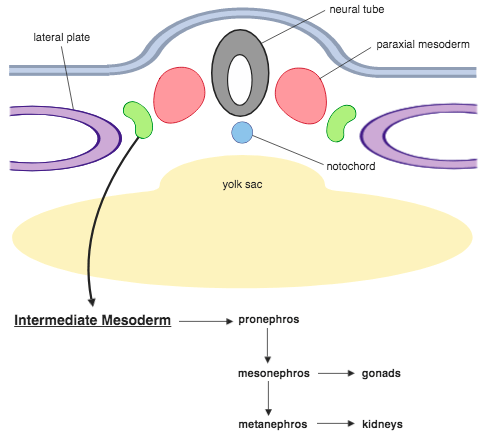
To simplified: Paraxial mesoderm is an initial stage in the development of the spine. It gives rise to somites, which are segmented structures that ultimately develop into the vertebrae and associated tissues of the spinal column. It also later develop as ribs which derived from the sclerotome. Sclerotome is a part of the somite.
Specifically, it is dorsolateral, meaning it is toward the back and the sides of the embryo, which could loosely align with the area between the spine and the ribs in a developing body. [5][6][7]
Since the testes originate near the kidneys in the lumbar region (which is close to the spine) and then descend into the scrotum during development, the intermediate mesoderm’s role in forming the gonads supports the idea of a developmental link to the region close to the spine and the ribs.[5]
The migrating primordial germ cells and embryonic fluids in this region contribute to the formation of the gonads and associated structures that later produce semen.
Surah 86:7 – He was created from a fluid, ejected, Emerging from between the backbone and the ribs.
Seems like the issue isn’t with the Quran, but with their inability to grasp the wisdom of Allah who created it all.
Dr. Laurence Brown wouldn’t be so dumb to miss this if it was a scientific contradiction before embracing Islam.
Insisting On Sperm
Critics will always insist that the fluid mentioned in this verse is sperm. This reflects a desperation to win the argument because they cannot afford to lose. It is easy to counter their delusional denial by providing another verses that explicitly mentioned sperm.
However, before we do that, it is important to identify which word carries this meaning. The inline translation on Quran.com has been activated so we can examine the verse word by word.
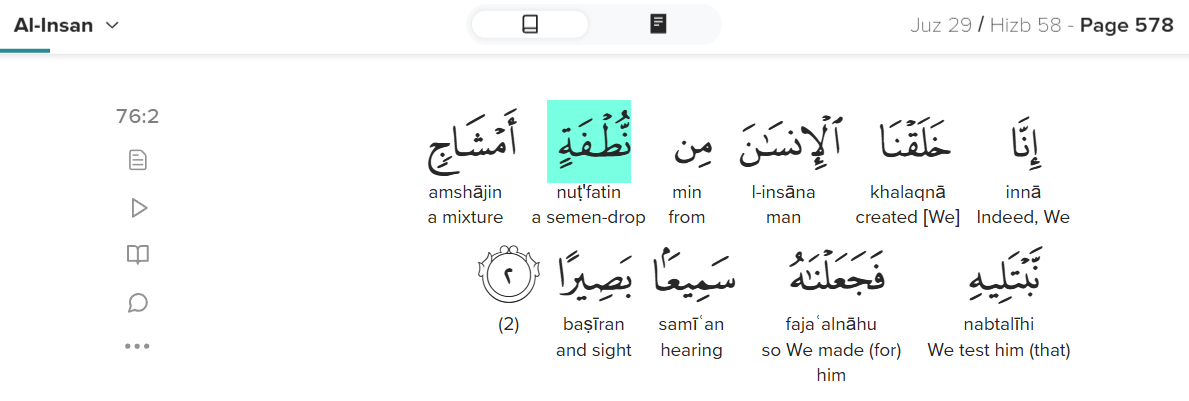

So it’s nut’fatin. The root word is “natafu”, below is the translation from Arabic Lexicon Lane.
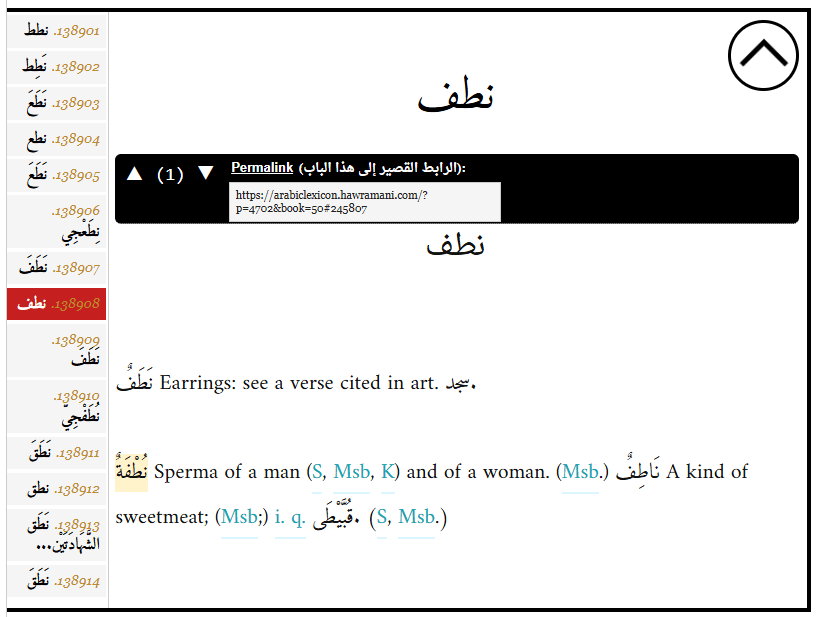

Even for those who is not familiar with Arabic able to see the form of the writing is exactly the same, “nut-fatun”. The different in sound of this word doesn’t make any different.
Wait, so how about the verse in Surah At-Tariq verse 6?
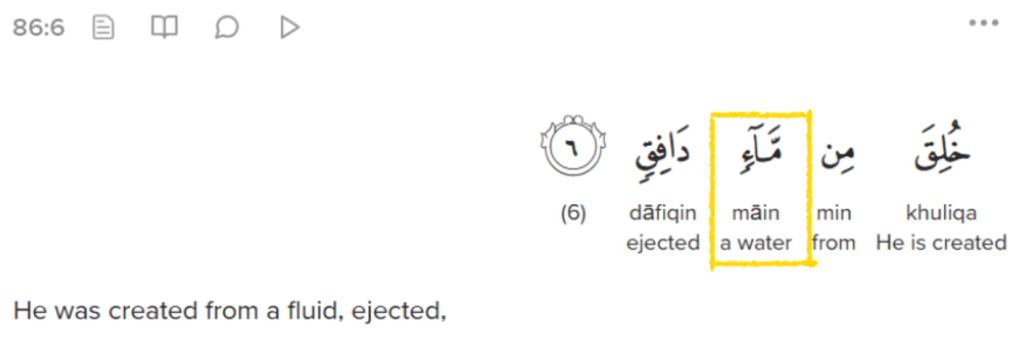
Nope. There is no “nutfah”, “nutfatin” or “natafu”. Instead, it’s “ma’in”.
We going to use Lexicon again. However, Dictionary Lane don’t have registry of this word.
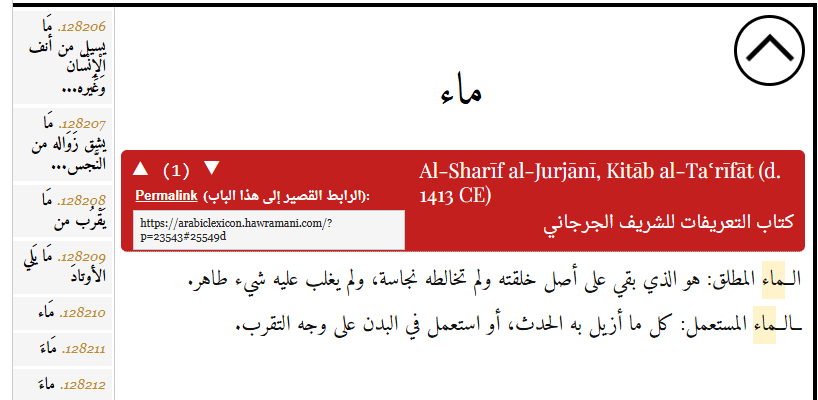
Therefore, we need to copy the URL and use web translator from Google.
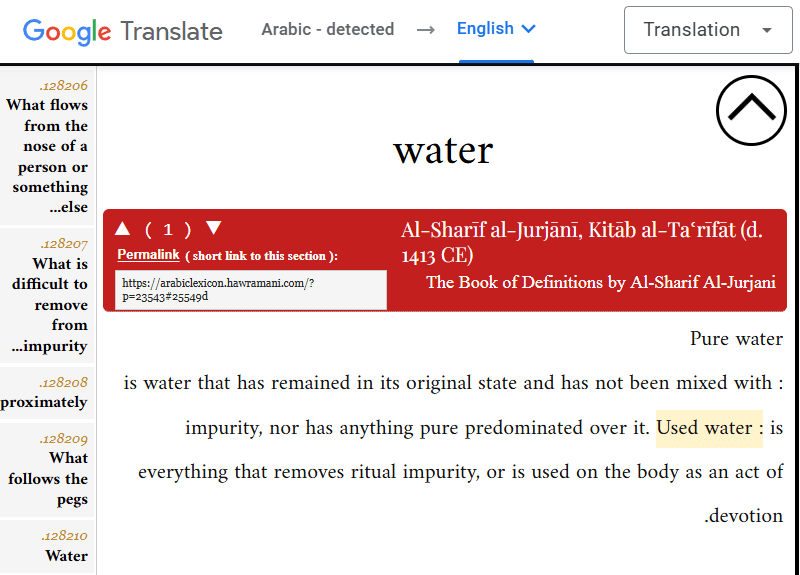
It’s water!
Now let’s go back to business. Here is the verses that have SPERM or NUTFAH.
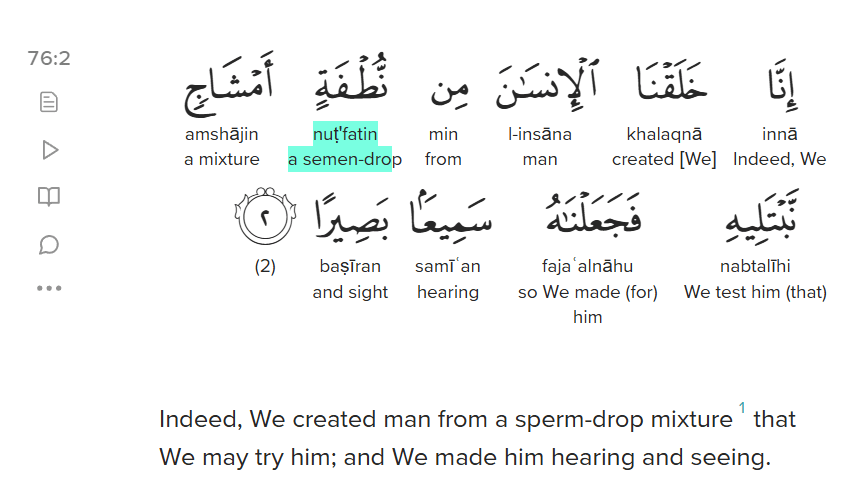
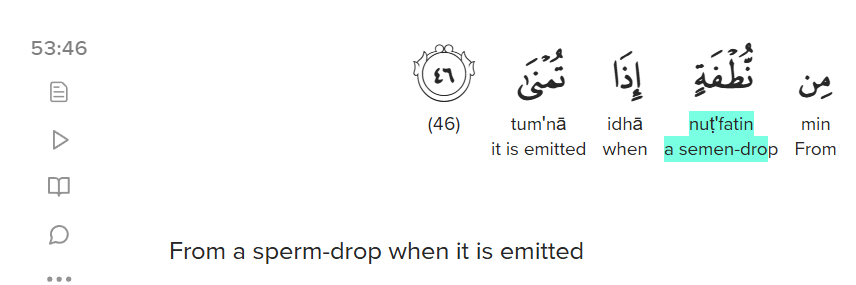
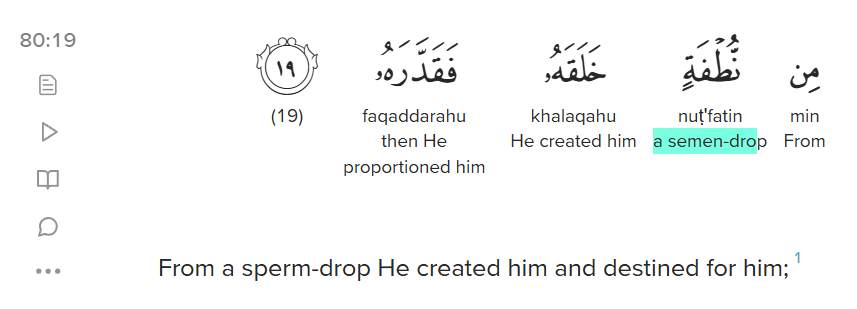
Conclusion
The Quran’s description in Surah 86:6-7 is not a scientific error but a profound statement that aligns with modern embryology and anatomy. The mention of the location between the ribs and spine in the Quran shows Allah’s All-Knowing nature and wisdom. Instead of naming “sperm” or “testes,” Allah refers to the region where gonadal differentiation taking place. It’s a stage where gonads develop during embryonic growth, including the origins of both testes and ovaries, emphasizing their role in human reproduction.
SUBHANALLAH! ALLAHUAKBAR!
The issue lies not with the Quran but with the inability of its detractors to appreciate its wisdom. Imagine, just to explain 2 sentences in a verse of Al-Quran require a deep understanding and explanation of human biology like this. This is insane! If you are a disbeliever and reading this, ask yourself, can you find any scriptures with difficulty level millions/10 like this. I can guarantee, none!
As the verse reminds us, all creation points back to the One who made it:
“Indeed, He is Able to bring him back.” (Surah At-Tariq 86:8)
To the critics trying desperately to twist this verse into a contradiction: maybe take a breath and check your facts next time. Your misinterpretations are like shooting arrows in the dark—missing the mark every single time. Honestly, the Quran’s wisdom is shining so brightly, it’s making your arguments look even weaker. Maybe it’s time to admit defeat and just embrace the brilliance.
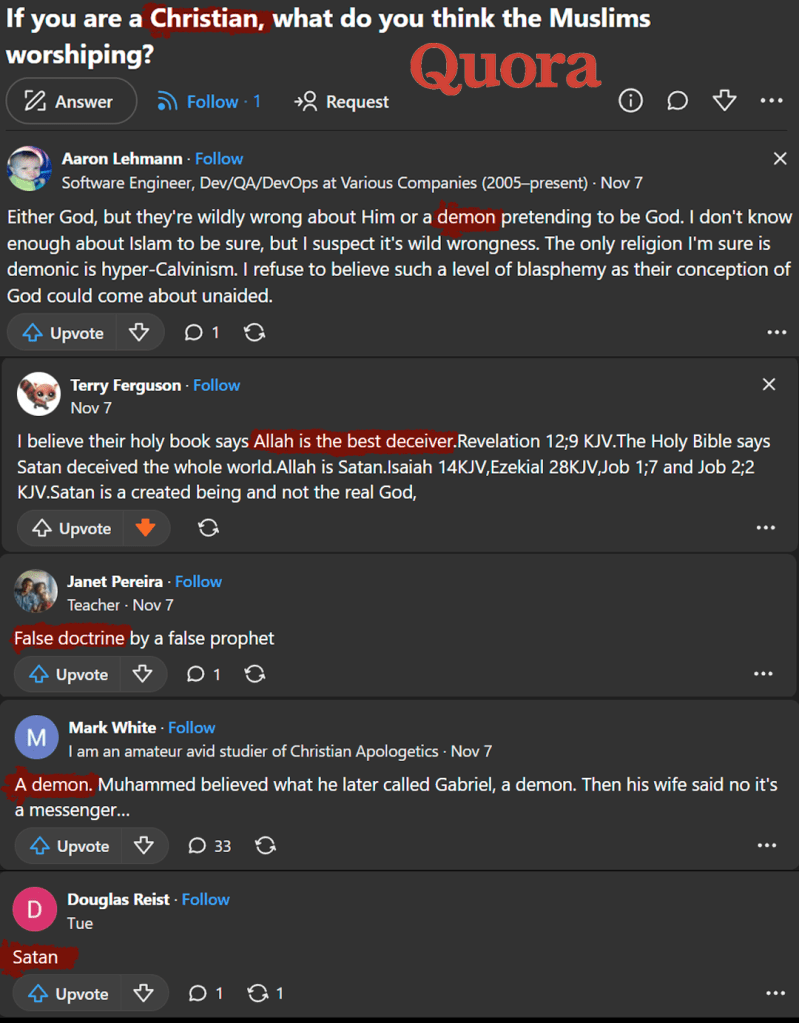
Answering accusations of:
Worshiping | Immorality | Terrorism | Scientific | Nonsense






Citations:
- Development of the gonads. (2024, November 13). Wikipedia. https://en.wikipedia.org/wiki/Development_of_the_gonads
- Mroueh, J., & Arabi, M. (2023). Gonadal differentiation. In StatPearls. StatPearls Publishing. Retrieved January 12, 2025, from https://www.ncbi.nlm.nih.gov/books/NBK557601/#:~:text=Gonadal%20differentiation%20is%20the%20process,formation%20of%20the%20gonadal%20primordium
- Descent of the testes. In Embryology. Retrieved January 13, 2025, from https://embryology.ch/en/organogenesis/genital-system/differentiation-of-gonads/descent-testes.html
- UNSW Embryology. (2025). Ovary development. Retrieved January 12, 2025, from https://embryology.med.unsw.edu.au/embryology/index.php/Ovary_Development
- Intermediate mesoderm. In Wikipedia. Retrieved January 13, 2025, from https://en.wikipedia.org/wiki/Intermediate_mesoderm
- Intermediate Mesoderm – Embryonic Development & Stem Cells. (n.d.). LifeMap Sciences. Retrieved January 13, 2025, from https://discovery.lifemapsc.com/in-vivo-development/intermediate-mesoderm
- Intermediate Mesoderm – an overview. (n.d.). In ScienceDirect Topics. Retrieved January 13, 2025, from https://www.sciencedirect.com/topics/agricultural-and-biological-sciences/intermediate-mesoderm



 Infiniti Islam