

Among the many tired accusations thrown at the Qur’an, one of the most desperate is the claim that Islam teaches the sky is a solid dome, a kind of cosmic ceiling stretched over a flat earth. This allegation is often repeated by anti-Islamic polemicists who seem to rely more on mockery than linguistic comprehension. Let’s not forget the pages that disguise themselves as Islamic educators but in truth distort the message — spreading falsehoods that corrupt the pure teachings of the Qur’an and the Messenger of Allah.
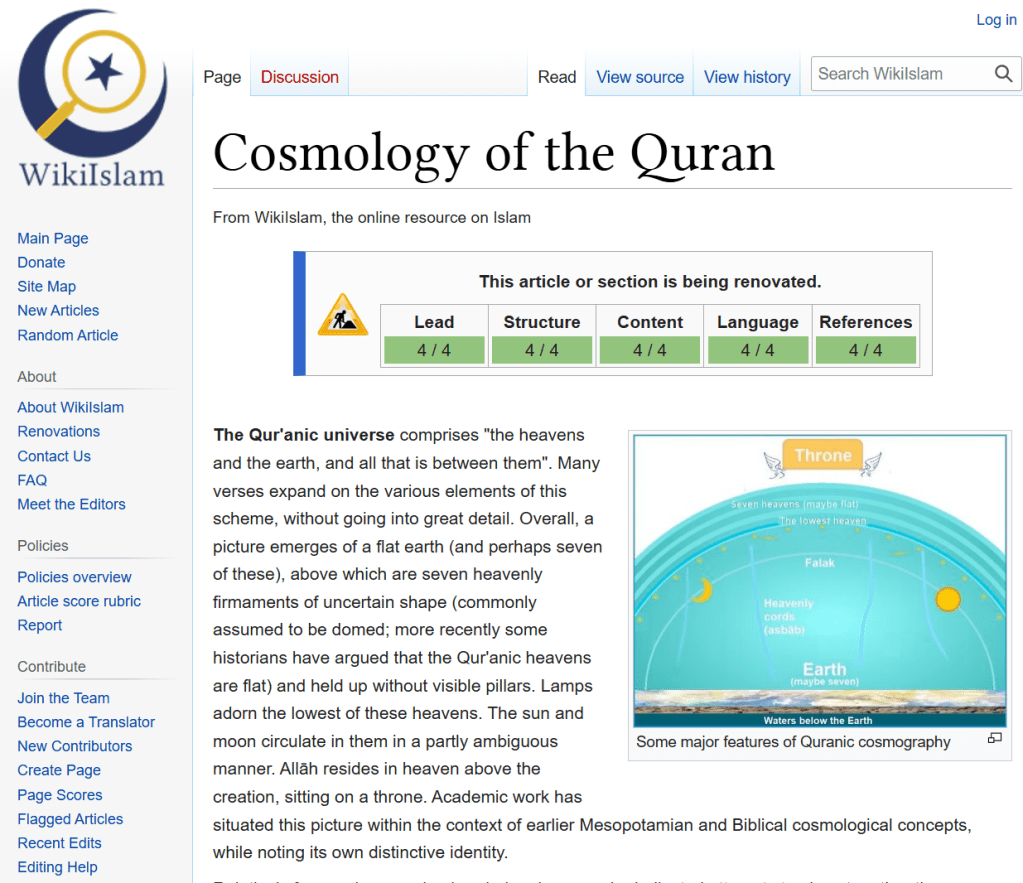
They quote certain verses especially from Surah Al-Baqarah (2:22) and Surah Al-Anbya (21:32) to say that the Qur’an describes a “sky” (wal sama’a binaa’an) or a “canopy or roof,” and from this, they imagine a metal vault covering the world.
[He] who made for you the earth a bed [spread out] and the sky a ceiling and sent down from the sky, rain and brought forth thereby fruits as provision for you. So do not attribute to Allāh equals while you know [that there is nothing similar to Him].
Saheeh International
– Surah Al-Baqarah (2:22)
And We made the sky a protected ceiling, but they, from its signs, are turning away.
Saheeh International
– Surah Al-Anbya (21:32)
But what’s really going on here?
Let’s peel this apart carefully—linguistically, historically, scientifically, and theologically.
The Desperation To Win
THERE IS NO DOME in the verses!
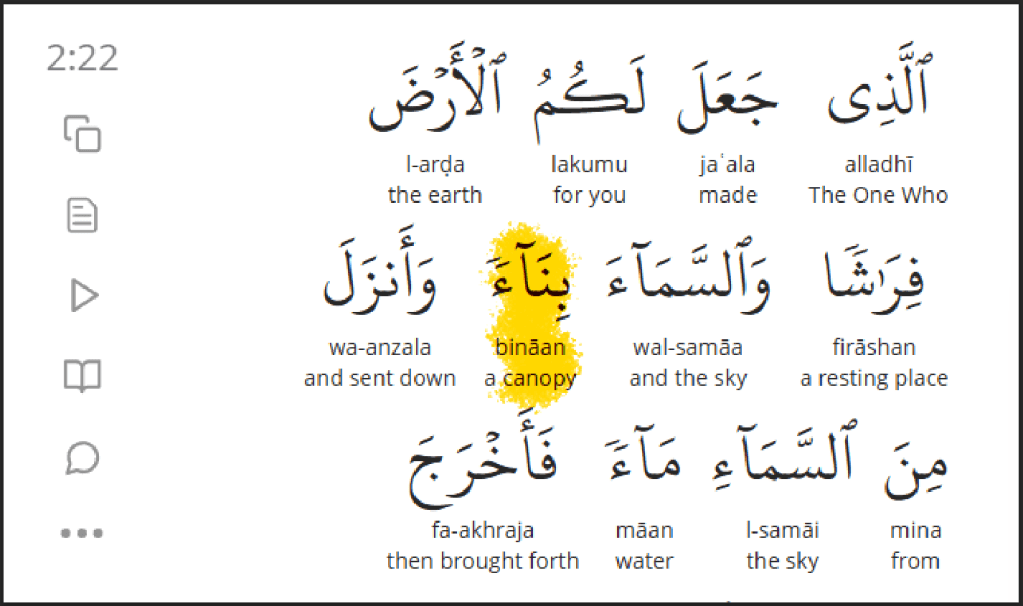
When Allah says “We built the sky as a binaa’an”, the point isn’t that the sky is made of wood, iron, or stone. It’s that the sky is structured, organized, sustained, and purposeful. It reflects intelligent design, not chaotic chance, as atheists claim.
The Qur’an consistently uses metaphors to invoke awe, not technical descriptions of physics. To mistake eloquence for engineering is like accusing Shakespeare of bad geography because he called the heavens “painted with silver stars.”
Another example of the use of metaphor can be seen in the Surah An-Naba.
78:8 – And We created you in pairs
78:9 – And made your sleep [a means for] rest
78:10 – And made the night as clothing
Here, clothing symbolizes comfort, cover, and intimacy. The night “clothes” the world, wrapping it in darkness and tranquility, shielding human activity, and providing psychological rest.
It does not suggest that the night is made of fabric; rather, it behaves like clothing, concealing, protecting, and softening. The imagery is tender and domestic, evoking a feeling of safety beneath a blanket.
Isn’t it beautiful?
Context Matters: Poetry, Not Physics
Arabic, especially Qur’anic Arabic, operates on a layered linguistic system where words carry semantic, symbolic, and emotional weight. In fact, there is even a verse that directly refutes the “solid dome” notion. In Surah Ar-Ra’d (13:2), Allah says, “It is Allah who raised the heavens without pillars that you can see.” This alone dismantles the dome theory nonsense, for a dome requires visible support or structure, while the verse explicitly denies any such physical pillars. When Allah later describes the sky as a “roof” or as being “held up” (22:65), He is not giving a lesson in astrophysics but rather drawing attention to its stability and order without visible support, a phenomenon that has long amazed human observers.

This verse is brilliant. It doesn’t say there are no pillars; it says “without pillars that you can see.” That leaves the door open for invisible forces like gravity, spacetime curvature, cosmic balance. The Qur’an doesn’t contradict modern science; it prefigures it in language accessible to all times.
Ancient Cosmology vs. Qur’anic Precision
In ancient cosmology—Babylonian, Greek, and even early Jewish thought that the heavens were indeed imagined as solid domes made of crystal or metal. The Bible’s Book of Genesis (1:6–8) explicitly describes a firmament (Hebrew: raqia)—a hard expanse dividing the waters above and below.

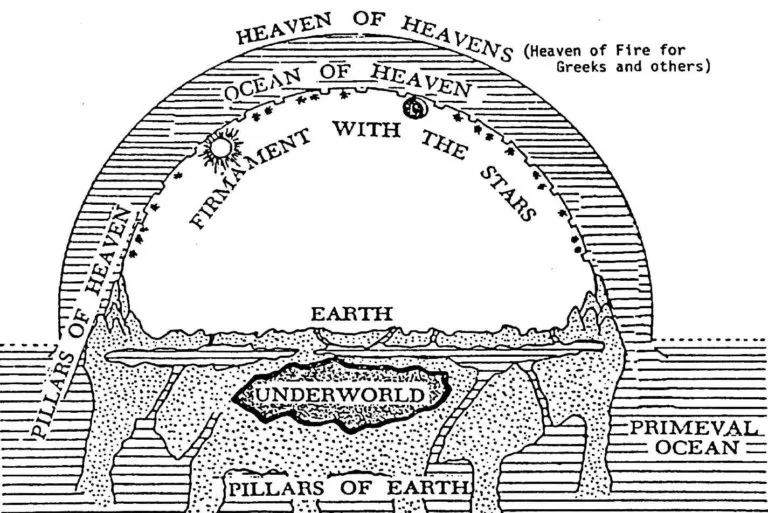
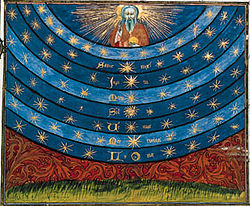
Greek philosophers like Anaximenes and Eudoxus proposed crystal spheres that held the stars.
Yet, unlike those descriptions, the Qur’an never uses language implying hardness or solidity for the sky.
Nowhere does it say “iron dome,” “solid shell,” or “metal vault.” Instead, the Qur’an uses terms like “samā’” (sky, elevation), “binaa’” (construction), and “masroof” (expansion, structure). Each pointing to function and aesthetic purpose, not material composition.
This linguistic precision alone should make critics pause. How did a 7th-century man in the desert avoid the same cosmological mistakes that dominated civilizations for thousands of years—if not through divine authorship?
The Sky as a “Canopy”: Metaphor for Protection
One of the Qur’an’s most fascinating descriptions appears in Surah Al-Anbiya (21:32):
And We made the sky a protected roof, but they, from its signs, are turning away.
Al-Anbya (21:32)
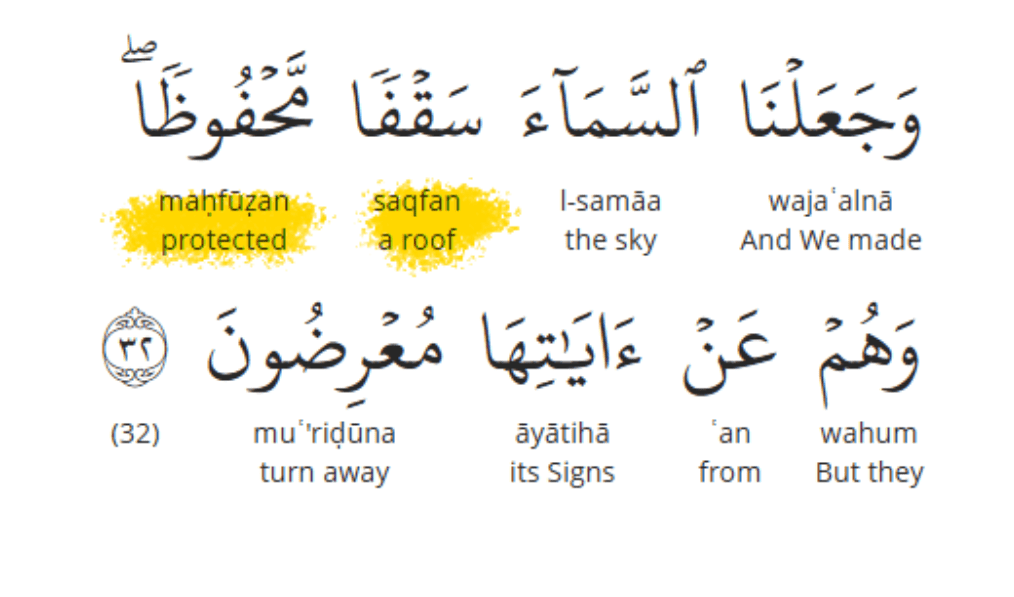
The phrase “protected roof” (saqfan mahfuzan) is not about solidity—it’s about protection. What do we know today?
- The ozone layer shields life from ultraviolet radiation.
- The magnetosphere deflects harmful solar wind.
- The atmosphere burns up meteors before they reach the ground.
In modern physics, this verse describes an invisible defensive system encasing Earth, exactly as the verse says, a protected roof, not a physical dome.
7th-century Arabs couldn’t have understood this scientifically, but they understood the message emotionally and through reason that something above them was protecting them. Today, we understand the literal mechanisms of that protection, and the Qur’an’s description fits perfectly.
To give more perspective, let the picture speak for itself.
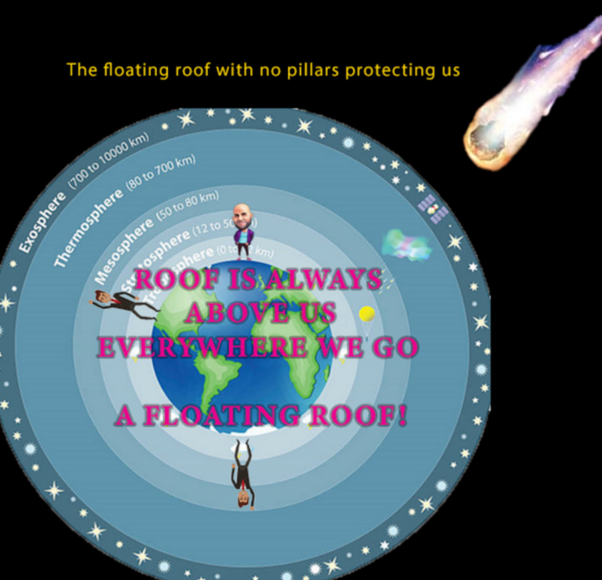
Key points: floating roof, no pillars.
Primitive Assumption of The Disbelievers
So no — the Qur’an doesn’t describe a solid dome above a flat earth. That’s a strawman built by those who never looked past their own mockery.
The Qur’an speaks in layers combining linguistic, poetic, and scientific arguments all at once. What appeared to ancient listeners as poetic beauty now unfolds as scientific truth. A roof without pillars you can see, a protected roof guarding life, these metaphors pregnant with precision.
If this Book had been born of seventh-century ignorance, it would’ve shared the same flaws as Babylonian, Greek, and Biblical cosmologies; domes of metal, pillars of clouds, and celestial oceans above the stars. But it didn’t. Instead, it stood alone, describing a sky both protective and vast, both elevated and expanding.
That’s not the voice of a desert poet guessing at the heavens.
That’s the voice of the One who built them.
So before accusing the Qur’an of primitive cosmology, maybe it’s time to admit the primitive assumption lies not in the scripture, but in the reader.
| Linguistics | Astronomy | Biology | Entomology | Genetics | Oceanography | Geology | Physics |



 Infiniti Islam