

Who Still Thinks the Qur’an Says the Earth Is Flat?
Let’s be honest — the internet is full of confident people who don’t read.
Every once in a while, one of them appears with a smirk and claims, “The Qur’an teaches that the world is geocentric, flat, and that the sun goes around the Earth!”
Really? Which verse, exactly?
Because every time you ask, they’ll mumble something about “the sun running” or “the earth spread out,” then call that a scientific discovery of stupidity.
But if we actually open the Qur’an, read it in its original Arabic, and grasp the eloquent style in which it speaks, we’ll quickly realize that the problem isn’t with the Qur’an at all. Even when reading the translations, it’s impossible to interpret it the way critics claim.
It’s with people pretending to be scholars after watching three YouTube shorts.
What “Geocentric” Means

The geocentric model is an ancient belief that places Earth at the unmoving center of the universe, with the Sun, Moon, and stars revolving around it.
Some critics claim that the Qur’an supports this outdated idea. But such accusations almost always stem from reading verses in a purely literal way, without understanding their linguistic depth or context.
The Misquoted Verses
Let’s take their greatest hits.
surah yasin
And the sun runs [on course] toward its stopping point. That is the determination of the Exalted in Might, the Knowing.
Surah Ya-Sin 36:38
Critics jump on this verse, claiming it proves the Qur’an thought the Sun orbits the Earth.
The verse simply describes the sun is moving. Something we know is scientifically accurate. The sun does move, orbiting around the center of our galaxy at about 828,000 km per hour.
So the verse isn’t saying the sun goes around the earth. It just saying the sun moves in its path. That’s like accusing someone of being geocentric because they said, “the sun rises.”
What about “the stopping point”? Doesn’t it say the sun stop?
No my friends. It doesn’t. Look and read again. It simply says the sun moves. It still moving though…towards a stopping point.

Where is the stopping point you ask? Well, nobody knows! However, we all know it’s going to stop one day. The universe is dying you see.
surah al-kahf
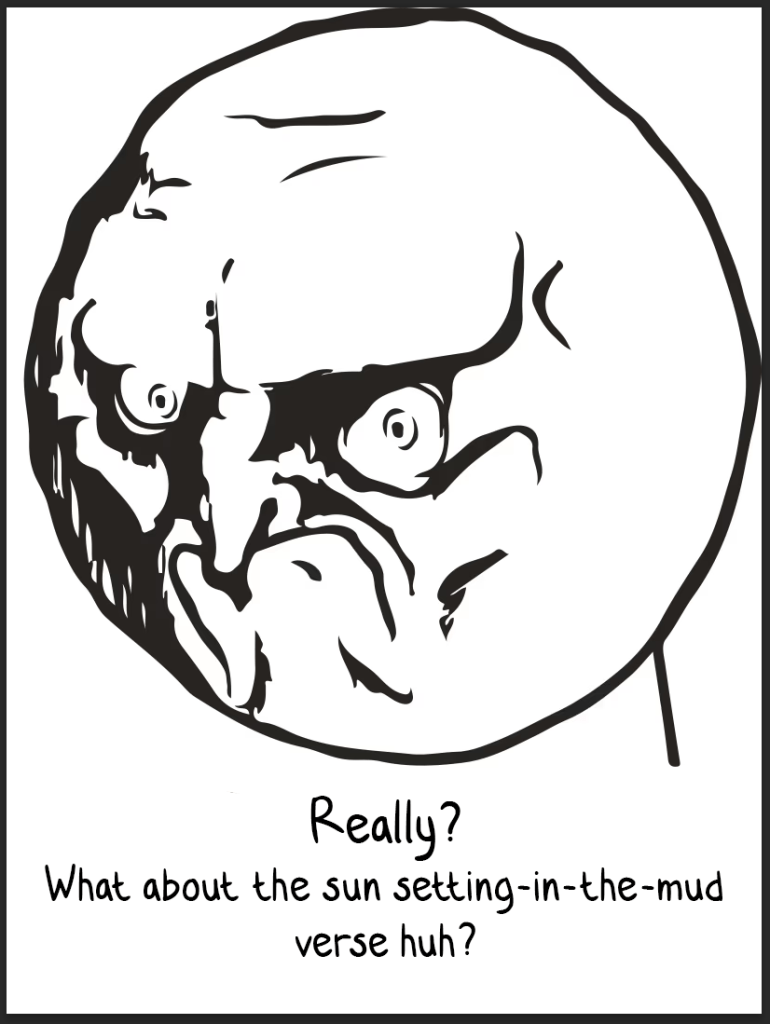
Ah yes — the classic Surah Al-Kahf (18:86) argument:
Until, when he reached the setting of the sun [i.e., the west], he found it [as if] setting in a body of dark water, and he found near it a people. We [i.e., Allāh] said, “O Dhul-Qarnayn, either you punish [them] or else adopt among them [a way of] goodness.”
Surah Al-Kahf (18:86
Anti-Islam polemicists love this verse. But anyone who has ever watched a sunset knows exactly what it means.
The verse is describing what Dhul-Qarnayn saw from his perspective, not what the Quran claims as literal cosmology. Don’t tell me I need to explain what does “he found it” means. This simple English clearly indicates a perceptual observation, not a physical fact. It’s like saying, “the sun set into the ocean.” Nobody thinks the sun literally sinks into the water.
So if someone still reads this verse and insists the Quran teaches the sun literally plunges into mud, maybe the problem isn’t the scripture. It’s absolutely with the reader – Can’t accept the loss!
Surah Al-Anbiya:
And it is He who created the night and the day and the sun and the moon; all [heavenly bodies] in an orbit are swimming.
Surah Al-Anbiya 21:33
They say this verse implies that the sun and moon orbit the Earth. In reality, it doesn’t specify around what. Moreover, the verse can be seen as implicitly refuting the long-held belief that the Sun is stationary at the centre of the universe. For instance, in the early 20th century Harlow Shapley showed that the Sun is not at the centre of the Milky Way but lies tens of thousands of light-years from it and is in orbit around the galaxy’s centre.[1] Later, Jan Oort provided stronger evidence of the Milky Way’s rotation and calculated that the Sun (and the solar system) orbit the galactic centre.[2]
In short, the verse actually implies all celestial bodies are in motion, which perfectly matches modern cosmology.
What the Quran Actually Says About the Cosmos
Nowhere does the Quran claim that the universe revolves around the earth. In fact, the Quran constantly describes a dynamic, expanding, and ordered cosmos:
“And the heaven We constructed with strength, and indeed, We are [its] expander.” (Surah Adh-Dhariyat 51:47)
That verse alone refutes the idea of a stagnant, geocentric universe. It implies motion, expansion, and design. A concept modern science confirmed over a thousand years later.
What About the Shape of the Earth?
Then we have the flat-earth claim. Critics love to “weaponize” the translation “spreading out” as mentioned in Surah Taha:
[It is He] who has made for you the earth as a bed [spread out] and inserted therein for you roadways and sent down from the sky, rain and produced thereby categories of various plants.
Surah Taha 20:53
Tell you what. Spreading a carpet, bed or whatever need not be flat.

This issue is very simple to understand and it’s not rocket science. I won’t go into detail here since I’ve already written a full article on the topic. But if you’d like to learn more, you can check it out at this link. | The Shape of Earth |
What the Great Muslim Scholars Said
Long before Europe even settled the question, Muslim scientists already understood the earth was round and not the center of the universe.
- Al-Biruni (973–1048) measured the earth’s circumference with astonishing precision, and wrote explicitly that the earth is spherical.
- Ibn Hazm stated that “the earth is a sphere, and so are the heavens.”
- Ibn Taymiyyah, in Majmu’ al-Fatawa, said: “It has been agreed upon by scholars that the heavens are spherical, and the earth as well.”
- Al-Farghani (Alfraganus) and Ibn al-Shatir made astronomical models that anticipated heliocentric principles centuries before Copernicus.
When you have a millennium of Islamic scholarship describing a spherical, orbiting earth, the claim that “Islam says the earth is flat” becomes embarrassingly unserious even if it’s coming from tafsir Al-Jalalyn.
The Real Issue
Let’s be honest. This isn’t about science. It’s about pride. Some people are so desperate to make the Quran look wrong that they’ll twist language, ignore context, and skip 1,400 years of scholarship just to “win” an argument.
But if the goal is truth, not ego, then the evidence speaks for itself:
- The Quran describes an expanding universe.
- It acknowledges the motion of celestial bodies.
- It portrays the earth as a sphere suitable for life.
- And Muslim scientists have always understood it that way.
So the next time someone says “The Quran is geocentric”, maybe ask them a simple question:
“Which verse says that — or did you just read that from another Reddit comment?”
| Linguistics | Astronomy | Biology | Entomology | Genetics | Oceanography | Geology | Physics |
References:
- The Editors of Encyclopaedia Britannica. (2025, October 16). Harlow Shapley. Encyclopaedia Britannica. Retrieved from https://www.britannica.com/biography/Harlow-Shapley
- The Editors of Encyclopaedia Britannica. (n.d.). Jan Oort. Encyclopaedia Britannica. Retrieved October 22, 2025, from https://www.britannica.com/biography/Jan-Oort



 Infiniti Islam